

From Station West to Baima: The Real Route for Smart Buyers
Listen, I've been standing in the same spot at Guangzhou Station West Clothing City for over fifteen years. You see me here every morning before 6 AM, checking the inventory, arguing with logistics guys about shipping weights, and watching the sunrise over the chaotic streets of Yuexiu District. When overseas buyers ask me, "How far is it from Station West to Baima?" or "Should I go to Baima instead?", my answer is always the same: they are two different worlds, even though they sit right next to each other.
I'm not going to give you a tourist map. I'm going to tell you how we actually move goods between these hubs. If you are looking for Guangzhou Station West clothing wholesale prices, you are in the right place. But if you think Baima is just a fancy version of what's down here, you're going to lose money. Let me break down the real distance, the real flow, and why mixing them up can kill your profit margin.
The Geography Myth: It's Not Just about Distance
On a map, Station West and Baima are practically neighbors. They are both connected to the Guangzhou Railway Station area. But physically walking from one to the other? That's a 15-minute walk through a crowd that feels like a mosh pit. However, the "distance" isn't measured in meters; it's measured in price tiers and customer types.
Station West: The Raw Powerhouse
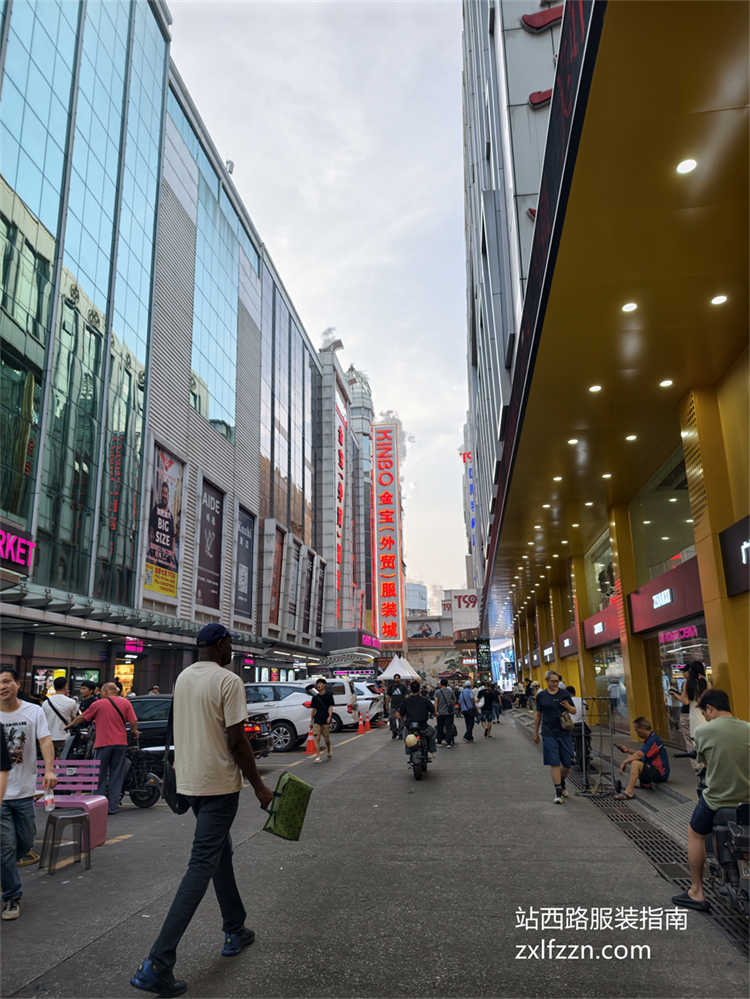
When I say Station West foreign trade, I mean the raw, unfiltered source. This is wher the factories dump their bulk. The buildings here—like the famous Jinhao (Jinbao) Foreign Trade Building—are stacked floor-to-ceiling with racks. The air smells like steam ironing and synthetic fabric. Here, you aren't buying "samples"; you are buying inventory. The minimum order quantities (MOQs) are aggressive. If you want to buy 50 pieces of a T-shirt, you might get laughed out of the door unless you know the right boss.
The prices here are brutal. A jacket that sells for $45 in the US retail market often costs me $8 to $12 wholesale right here in the back rooms of Station West. But you have to be tough. You have to haggle. You have to inspect every seam because the quality varies wildly from stall to stall.
Baima: The Showroom Upgrade
Now, cross that street and you hit Baima. It's cleaner, brighter, and has elevators. The staff here speak better English, and the displays look like something from Vogue. But let me be honest: you are paying for the rent and the ambiance. The same jacket I bought for $10 in Station West might be listed at $18 in Baima. Why? Because Baima targets high-end boutique owners who don't want to dig through piles of clothes. They want curated looks.
If you are a small startup buyer, Baima is a trap. The margins are too thin. But if you need consistent quality and branding for a mid-range chain store, Baima makes sense. The key is knowing which stalls in Baima actually source from Station West and which ones have their own factories.
Practical Sourcing Strategy: How We Move Goods
Over the years, I've seen thousands of buyers make the mistake of treating these markets as separate entities. They don't work that way. The supply chain flows like water. High-quality items start in the factories, move to Station West for bulk distribution, and then some trickle up to Baima for premium packaging.
The "Jinbao" Connection
You mentioned Jinbao Foreign Trade? That building is legendary. Located right in the heart of Station West, it's the hub for export-grade surplus. I personally recommend starting your search on the 3rd and 4th floors of Jinbao. That's wher the "export leftovers" live. These are items made for European brands that didn't sell, or slight defects that were fixed. You can find designer-style dresses for $5 and men's suits for $15.
Here is a trick: Don't just look at the front display. Ask the owner, "Do you have the 'back room' stock?" Most bosses will take you to a side room wher the real deals are hidden. In Jinbao, I once found a batch of winter coats that were originally priced at $120 in Europe but sold here for $22. That's the kind of margin that builds a business.
Navigating the Crowds
Getting from Station West to Baima isn't hard, but timing matters. If you arrive at 9 AM, the corridors are packed with locals rushing to catch buses. Wait until 10:30 AM when the rush subsides. Walk past the main entrance of Baima and head straight to the upper floors. The ground floor is mostly showrooms for big brands, but the 5th and 6th floors are wher the independent wholesalers operate.
I always advise my clients to spend 70% of their time in Station West and 30% in Baima. Use Station West to find the product and the price. Use Baima only to verify the quality and check the finishing details. Never buy your entire season's stock from Baima unless you have a massive budget.
Inspection and Negotiation: Avoiding the Pitfalls
This is wher most overseas buyers fail. They see a nice photo, send a deposit, and wait three months for a container full of junk. In Guangzhou, you must touch, feel, and test everything.
The "Touch Test"
In Station West, fabrics can be deceptive. A shirt might look thick in the light but feel like tissue paper under pressure. I teach my buyers to rub the fabric vigorously. Does it pill? Does the color bleed? Check the stitching density. In Guangzhou Station West clothing markets, a stitch count of less than 10 per inch is a red flag for durability.
At Baima, the quality control is generally higher, but the markup is steep. If you find a stall in Baima that offers factory-direct pricing, ask for their production certificate. Many stalls claim to be factories but are just middlemen reselling Station West goods. I've caught several doing this by asking for the factory address and verifying it on a map.
Negotiation Tactics
Never accept the first price. In Station West, the opening price is usually 40-50% higher than the real deal. Start by offering 30% of the asking price. Yes, really. Then negotiate up slowly. Bring cash or have your bank transfer ready; showing liquidity speeds up the deal. For repeat orders, I always push for a "loyalty discount." After buying five times from a stall, I expect a 5% dro in price. Most bosses will agree if you promise future volume.
Also, clarify the shipping terms immediately. Do they handle FOB (Free on Board) or EXW (Ex Works)? In Station West, many sellers only do EXW, meaning you have to arrange your own truck to pick up the goods. This saves them money but adds complexity for you. Always hire a local agent if you don't speak Mandarin fluently.
Summary: The Smart Buyer's Checklist
To wrap this up, let's look at the data. If you are sourcing 1,000 units of a basic T-shirt:
- Station West Price: $3.50 - $4.50 per unit (MOQ 500+)
- Baima Price: $5.50 - $7.00 per unit (MOQ 100+)
- Quality Variance: High in Station West, Low in Baima
- Best For: Bulk, fast turnover, custom branding
And for a premium dress line:
- Station West Price: $12.00 - $15.00 (requires heavy inspection)
- Baima Price: $18.00 - $22.00 (ready to ship, branded tags)
- Quality Variance: Medium in Station West, High in Baima
- Best For: Boutique chains, brand consistency, lower MOQs
Final Thoughts from an Old Shop Owner
Don't let the shiny lights of Baima fool you. The real power lies in the gritty, bustling alleys of Station West. Whether you are hunting for Jinbao foreign trade gems or navigating the endless rows of Guangzhou Station West clothing, remember that relationships matter more than location. Find a few trusted bosses, build trust, and visit regularly. The market changes every day, but the rules of good business remain the same: transparency, quality, and fair negotiation.
So, when you plan your trip, start early. Go straight to Station West, hit the Jinbao building, and only step into Baima if you need to polish your final selection. That's how you win in Guangzhou. Safe travels, and may your containers be full.



 On-site Visits
 Free Sharing
 Avoid Scams
 Updated Frequently
 For Reference Only